

Key Takeaways:
- Agentic AI systems can make decisions, adapt to changing inputs, and take action toward specific goals — with varying levels of autonomy.
- The key difference between agentic AI and generative AI: generative AI creates content from prompts, while agentic AI reasons, plans, and acts independently to achieve outcomes.
- Agentic systems live on a spectrum of autonomy. Understanding the seven levels of agency helps organizations decide how much governance each system needs.
- Only 10% of businesses have scaled their AI agent experiments — the main bottleneck isn't the technology, it's governance.
- Implementing agentic AI requires regulatory compliance, ethical safeguards, transparency, and the ability to trace every decision an agent makes.
- Implementing Agentic AI requires regulatory compliance, ethical safeguards, and transparency.
Agentic AI refers to AI systems that can make autonomous decisions and take action toward specific goals — unlike generative AI, which only responds to prompts. It is one of the most talked-about ideas in technology right now.
Forbes called it "the next big breakthrough that's transforming business and technology." But when you ask people to define it clearly, things quickly get vague.
So what is agentic AI exactly, how does it differ from generative AI, and is it really going to change how we work?
What is Agentic AI?
Agentic AI systems are artificial intelligence systems that can act with some level of autonomy. They make decisions to achieve specific objectives based on input data. They're called "agentic" because they have agency — the freedom to decide how to approach a goal.
Unlike traditional AI that waits for instructions, an agentic system can adapt to changing circumstances or inputs and take the best course of action with limited or even no human oversight.
Example: how could a highly autonomous agentic AI work in practice?
Imagine you work for a large shoe retailer and you're responsible for supply chain operations. A highly autonomous agentic AI could independently manage your company's inventory. It would predict product demand based on real-time sales data and external factors like economic trends, fashion trends, or the season.
It would then adjust stock levels, place orders with suppliers, and optimize shipping routes to ensure timely deliveries — without human intervention.
Agentic AI systems exist on a spectrum, so while this example is highly autonomous, systems with more limited autonomy or stricter guardrails still qualify as "agentic."
Agentic AI vs regular AI: what’s the difference?
Agentic systems dynamically and autonomously adjust their approaches to meet their goals. Regular AI systems don't, because they lack autonomy.
Non-agentic AI includes generative AI tools that respond to prompts, and analytical or predictive models that learn rules from data but can't act on their own. Agentic AI systems, by contrast, can assess their environments and make informed decisions about the best next course of action.
Using our shoe retailer example:
- Regular AI: A traditional system might generate demand forecasts or suggest optimal inventory levels based on historical data. But it would need a human to act on that information — to place orders, adjust strategies, or reroute deliveries.
- Agentic AI: An agentic system could independently assess the stock situation, decide how much inventory is needed, place orders with suppliers, reroute deliveries, and even adjust pricing — all without waiting for human approval.
Agentic AI vs generative AI: what's the difference?
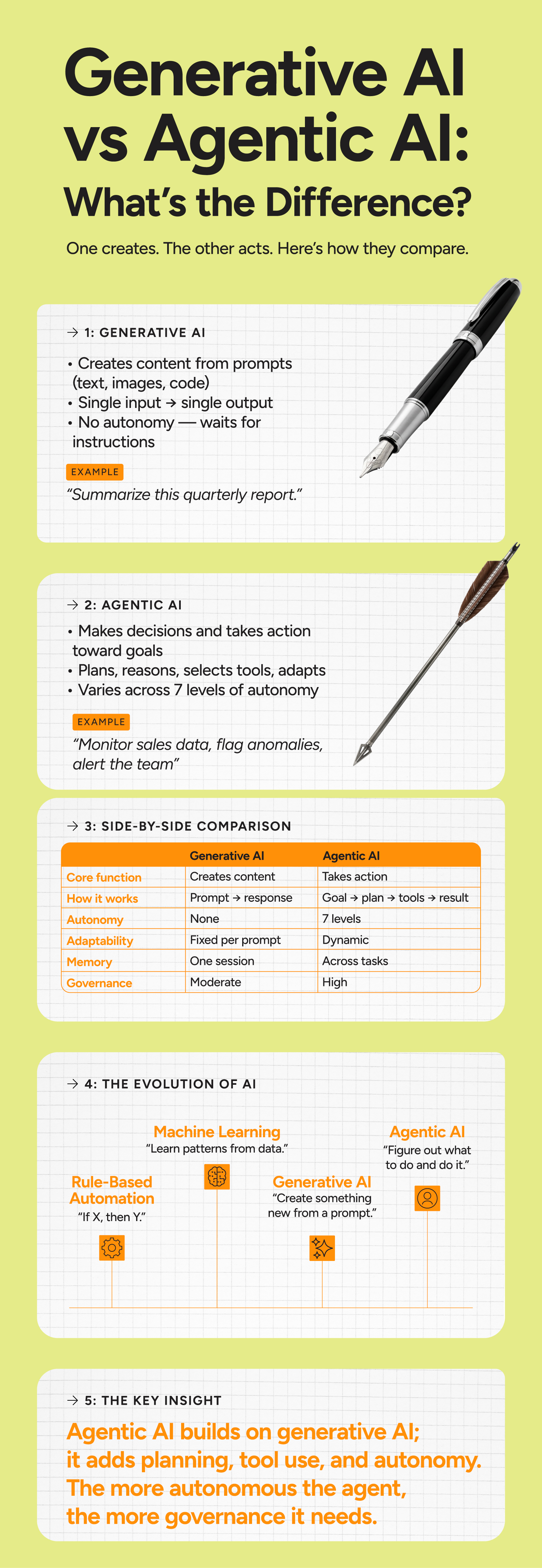
Generative AI and agentic AI are often mentioned together, but they solve different problems.
Generative AI creates. It takes a prompt and produces something new — text, images, code, summaries. Tools like ChatGPT and DALL-E are generative AI. You ask a question, you get an answer. The interaction ends there.
Agentic AI acts. It takes a goal and figures out how to achieve it. An agentic system can break a goal into steps, decide which tools to use, gather information from multiple sources, adjust its approach when something changes, and keep going until the job is done.
Think of it this way: generative AI is like a colleague who writes a great report when you ask for one. Agentic AI is like a colleague who notices the data looks off, investigates the root cause, drafts a summary, and emails your team — without you having to ask.
| Generative AI | Agentic AI | |
| Core function | Creates content from prompts | Makes decisions and takes action toward goals |
| How it works | Single input → single output | Plans, reasons, selects tools, adapts |
| Autonomy | None — waits for a prompt | Varies across seven levels of agency |
| Adaptability | Fixed per interaction | Adjusts approach dynamically based on results |
| Memory | Typically limited to one session | Can maintain context across tasks |
| Governance need | Moderate (output quality, bias) | High (decision accountability, data access, auditability) |
| Example | "Summarize this quarterly report" | "Monitor sales weekly, flag anomalies, alert the finance team" |
In practice, most agentic AI systems today use generative AI models as their reasoning engine. The agent decides what to do, and the generative model helps it think through each step. So the two aren't opposites — agentic AI builds on top of generative AI and adds planning, tool use, and autonomy.
Key features of Agentic AI systems
Agentic AI systems have autonomy, can adapt or spontaneously change their approach to meet a defined goal, and are context aware.
- Autonomy: The ability to operate independently once given an objective.
- Goal focus vs task focus: A focus on achieving specific outcomes or goals vs performing defined tasks without an understanding of the overarching goal.
- Adaptability: The ability to adjust strategies or next actions if the situation changes spontaneously to ensure it reaches its goals.
Many of the most relatable agentic AI use cases come from robotics and autonomous systems. A self-driving car, for example, includes an agentic AI system because it takes in environmental data and deploys safety precautions as needed.
However, even these systems are not fully agentic. They make decisions based on rules or constraints set by humans.
Agentic AI systems and their 7 levels of agency
Not all Agentic AI systems are created equal. Agency in AI exists on a spectrum vs in black and white terms. So the level of autonomy a system has can vary significantly.
The more autonomous and adaptable an AI system is, the greater the potential risks and governance challenges are.
Here's a breakdown of the various levels of agency in AI systems:
The 7 levels of agency in AI systems
| Level | Level of agency | Explanation |
| 1. | Reactive (non-agentic) | Responds to specific, predefined triggers or commands. Acts only when prompted. |
| 2. | Assistive (non-agentic) | Provides recommendations or analysis but requires human intervention for final decisions. |
| 3. | Semi-autonomous | Performs certain tasks independently within defined parameters. Still needs human approval for high-value actions. |
| 4. | Autonomous execution | Executes tasks without human intervention. Predefined rules govern its actions. |
| 5. | Autonomous adaptability | Adapts actions based on changing conditions. Learn from past experiences. Operates within human-set guidelines. |
| 6. | Goal-oriented autonomy | Autonomously sets and pursues long-term goals, adjusts strategies dynamically. Continuously learns without human input. |
| 7. | Full agency | Independently identifies problems, sets goals, and adapts in real time. Self-governing with minimal or no human oversight. |
Most real-world agentic AI systems today sit at levels three and four. Fully autonomous systems (level seven) remain in the realm of science fiction, for now.
Agentic AI: When is it useful and when not
Watch this video to learn how AI agents work, when we should be careful using them, and how KNIME helps keep everything under control.
Real-world applications of agentic AI
The potential for agentic AI spans industries, though practical implementations are still maturing.
- Supply chain optimization
An agentic system can monitor real-time sales data, predict demand shifts, adjust stock levels, place orders with suppliers, and reroute deliveries — reducing the manual coordination that slows most supply chains down.
- Financial reporting and audit
A data quality agent can ingest incoming financial data, validate it against expected formats, flag anomalies like duplicate entries or unusual variances, and generate a summary report.
- Customer support triage
An agentic system can read incoming support tickets, classify them by urgency, pull relevant documentation, draft a response, and route complex cases to the right team.
- Healthcare diagnostics
Agentic AI can analyze medical images, cross-reference patient history, and suggest potential diagnoses — supporting clinicians with faster, more comprehensive analysis.
- Autonomous vehicles
Self-driving cars use agentic AI to process real-time environmental data, predict the behavior of other road users, and make split-second safety decisions.
Challenges in implementing and governing agentic AI
Agentic AI naturally gets hyped up. The possibilities are pretty cool. But in reality there are huge hurdles to overcome to implement and govern these systems safely and responsibly. Given their autonomy, ensuring compliance with legal and ethical standards is critical – especially in high-risk sectors like finance, healthcare, or infrastructure.
The EU AI Act and the US Executive Order on AI both set out guidelines for governing AI systems. Agentic AI could fall within any of the risk classifications of the EU’s AI Act based on its implementation. So an Agentic AI system within a video game would not fall into the high risk category. But an Agentic AI system running a nuclear power plant or flying a plane would. In these high risk environments companies need to follow strict protocols, including:
- Transparency: Users must understand how the AI system works and how it makes decisions.
- Data Governance: The data used by Agentic AI must be carefully managed to prevent biases or discriminatory outcomes.
- Documentation and Traceability: Every decision made by the AI must be traceable to ensure accountability, particularly if things go wrong.
In addition to these legal concerns, organizations must establish internal governance frameworks that allow for human oversight while still enabling the AI to function autonomously.
This means you also need to build "fail-safes" to override AI decisions in critical situations and ensure that all actions are auditable, which can be a real challenge with AI systems.
How to get started with agentic AI
You don't need to build a fully autonomous system to start experimenting with agentic AI. Many teams begin with semi-autonomous agents (level three) that handle specific, well-defined tasks with human oversight.
A practical starting point is a workflow where an AI agent takes a goal, decides which steps to follow, calls the right tools, and returns a result — while you can inspect every decision it makes.
Visual workflow platforms make this especially accessible because the agent's reasoning is visible as a step-by-step process, not hidden inside code. If you want to try building your first agent, start with this step-by-step guide or explore workflow collection on KNIME Hub.
Here's a 30-min course on Data-Aware Agentic AI you can do to get started with building agentic AI systems that can use tools, reason, and securely work with your data
What’s the future for Agentic AI?
Agentic AI offers huge potential across industries, from supply chain optimization to autonomous vehicles. However, despite the hype we are still quite a long way from having many truly ambitious agentic systems in operation.
The more autonomous AI systems become, the more responsibility, governance requirements, and risk there is.
Organizations must implement strong governance frameworks, adhere to evolving regulations like the EU AI Act, and be able to explain how Agentic AIs have made decisions and reproduce results – which can be very difficult to do since AI models are often non-deterministic.
While Agentic AI is currently a much hyped advancement in AI, safe and secure implementations and use cases are few and far between. We can expect to see AI systems becoming gradually more autonomous in line with the 7 levels outlined above, but fully autonomous systems are still entirely in the realm of science fiction. For now at least.
Agentic AI FAQs
How is Agentic AI different from RPA?
Agentic AI – unlike RPA systems – can make autonomous decisions and adapt to changing environments. RPA, on the other hand, follows predefined, rule-based workflows for repetitive tasks. While RPA automates specific processes, Agentic AI is capable of reasoning and responding to dynamic situations independently.
What is the difference between generative AI and Agentic AI?
Generative AI creates new content based on patterns learned from data, like generating text or images. Agentic AI makes autonomous decisions and takes actions to achieve specific goals, adapting to new information and environments, usually without human intervention. However, the current iteration of Agentic AI does rely on generative AI models like GPT4o as a central component, so they are not always perfectly distinguishable.
What are the best tools for building agentic AI?
Code-first frameworks like LangChain or CrewAI give developers full flexibility but require Python expertise. Visual workflow platforms like KNIME let you build, test, and govern agents without writing code — making them accessible to data analysts and domain experts. The best choice depends on your team’s skills and governance requirements.
Can you build AI agents without coding?
Yes. Visual, no-code platforms allow you to design agentic workflows by connecting components in a drag-and-drop interface. Each step in the agent’s reasoning is visible and auditable, which makes it easier to debug, explain to stakeholders, and comply with governance requirements.