

Automation is no longer one thing; it spans everything from simple rule-based workflows to systems that can reason, adapt, and act on their own. With so many capabilities available, it can be difficult to understand which approach fits which kind of task. Some processes are stable and predictable, some rely on understanding unstructured information, and others require the system to make decisions as conditions change.
Understanding the differences between traditional automation, generative AI, and agentic AI makes it easier to match the right method to the right job. This guide breaks down each approach and shows where it fits best, with practical examples drawn from real business scenarios.
What is traditional automation?
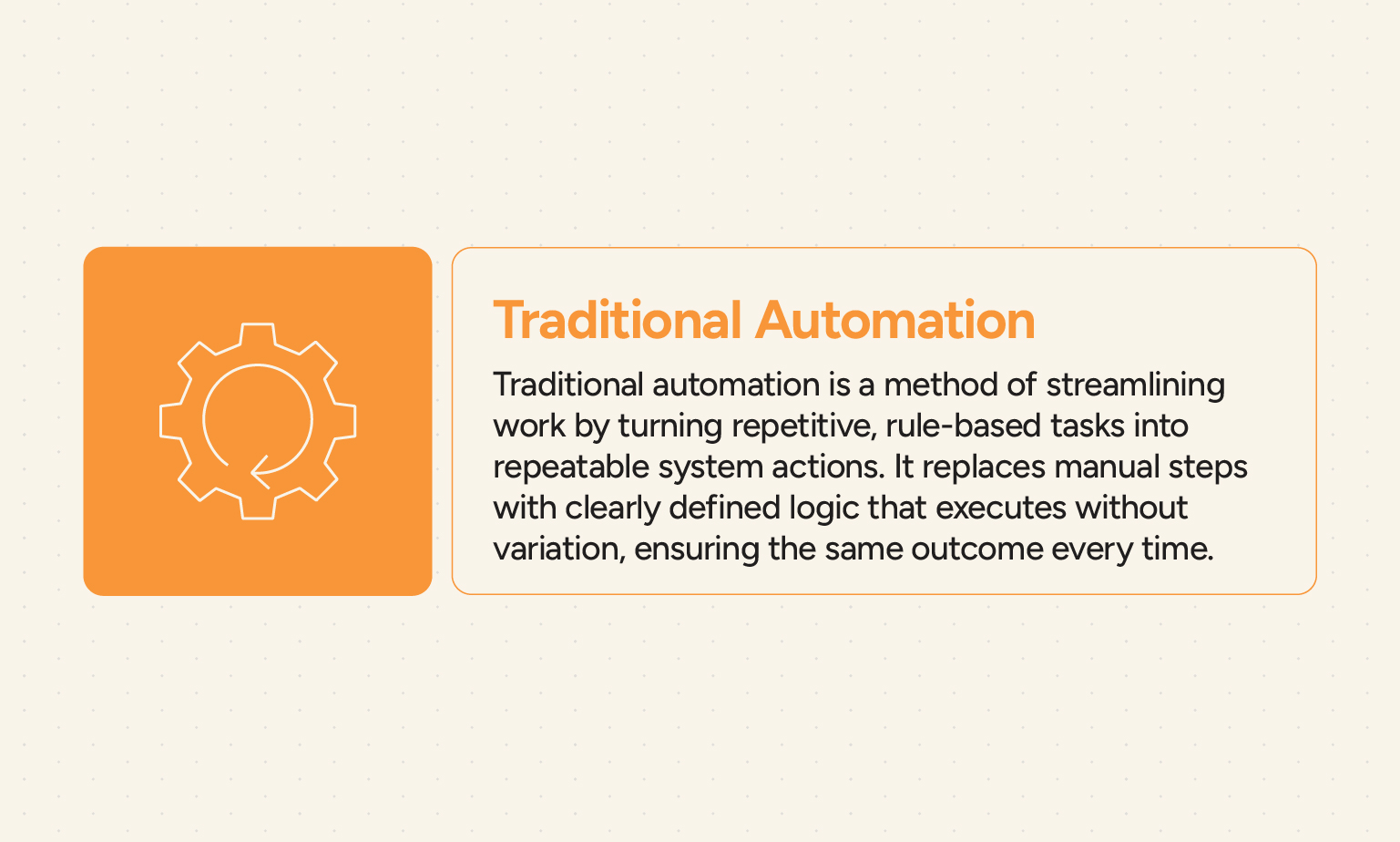
It works by following fixed, predefined rules. You decide the conditions, you define the steps, and the system carries them out exactly as instructed. It does not interpret, adapt, or decide; it simply follows the instructions you’ve set.
This makes traditional automation extremely stable, predictable, and easy to audit, which is why it remains the backbone of many operational workflows. When a process rarely changes, contains little ambiguity, and requires consistent outcomes, rule-based automation delivers exactly what the business needs without unnecessary complexity.
What are the key characteristics of traditional automation?
- Deterministic behavior: The same inputs always lead to the same outputs.
- Clear logic paths: Every step in the process is explicitly defined in advance.
- Structured inputs: Works best with clean, predictable data formats.
- High transparency: Every action can be documented and easily traced.
- Low flexibility: Any change in rules or structure typically requires manual updates.
When to best use traditional automation?
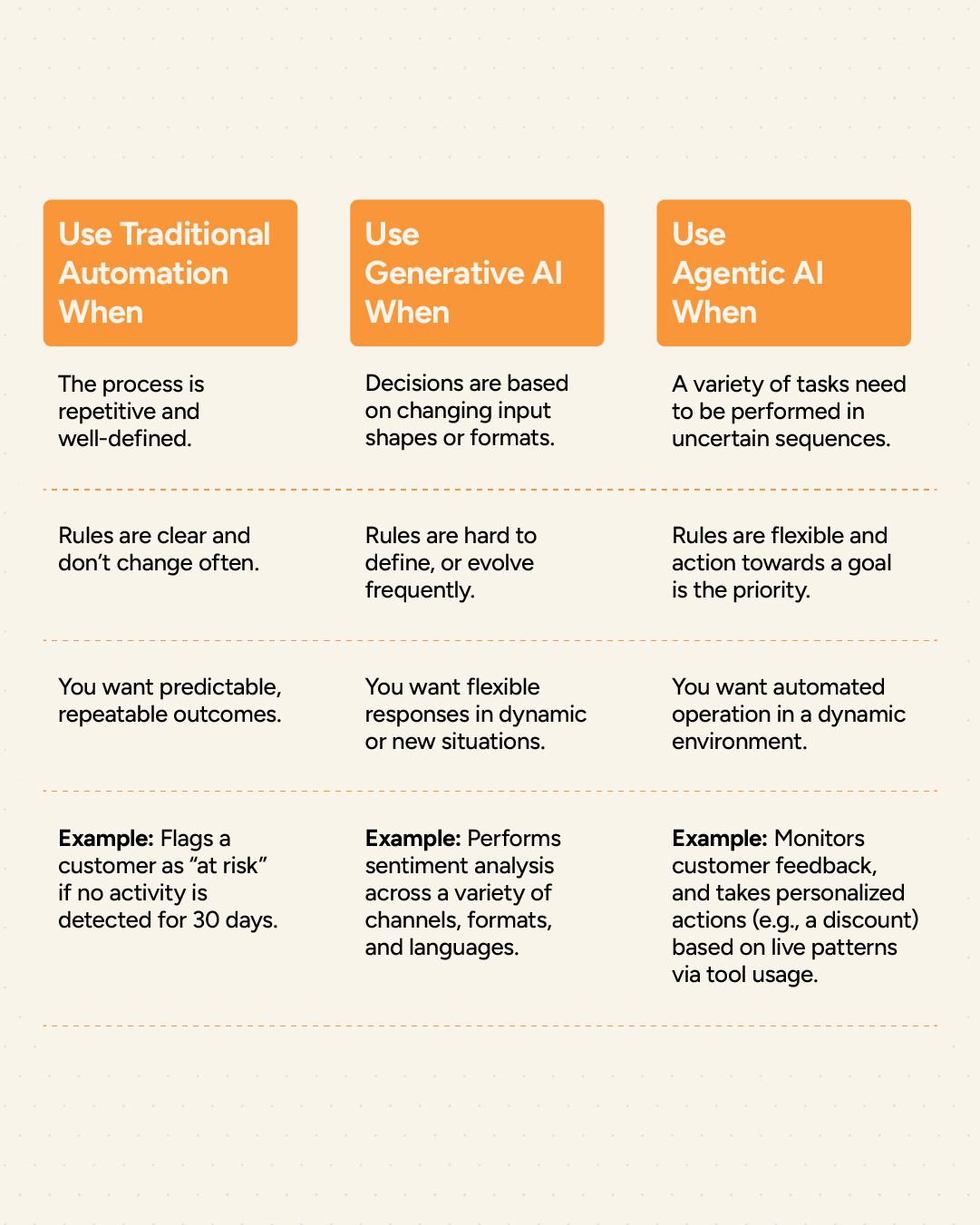
Traditional automation is the best fit when:
- Your workflow follows a stable, predictable pattern.
- The rules are known upfront and unlikely to change often.
- You need consistent, repeatable outcomes with minimal variation.
- Compliance or auditability is important.
- The task doesn’t require interpretation, judgment, or adaptation.
What's an example of traditional automation?
Imagine a retention workflow that flags a customer as “at risk” if they haven’t used the product for 30 days. The system checks one data point: the last activity timestamp, and compares it to the current date. If the gap exceeds 30 days, the “at risk” flag is set.
It’s a straightforward scenario: the input is structured, the rule is clearly defined, and the required action remains the same. Because the workflow follows a consistent pattern with no unexpected variations, traditional automation can handle it reliably without unnecessary complexity.
What is generative AI?
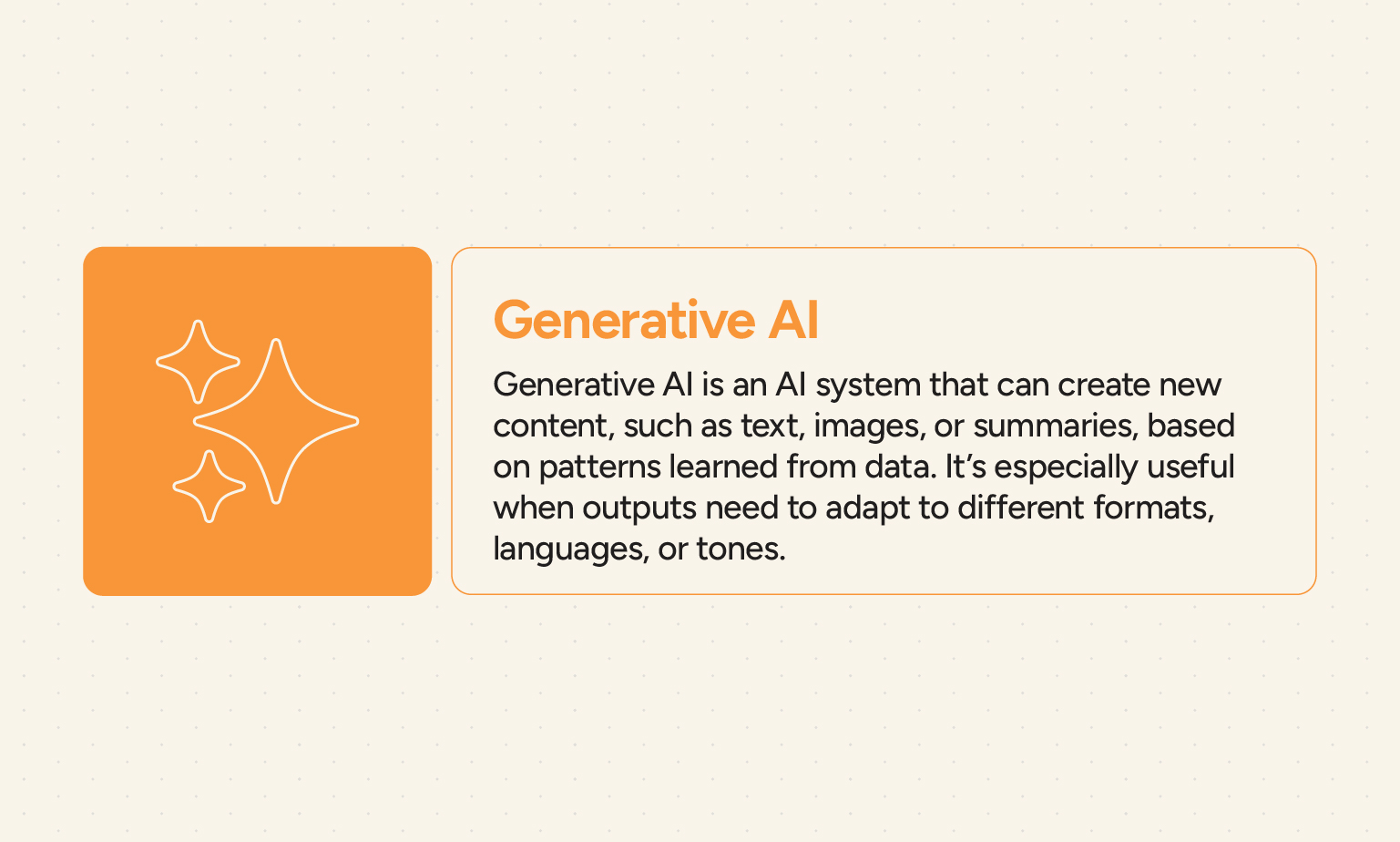
This approach works well for tasks where information is unstructured, text-heavy, or highly variable from one instance to the next. Instead of following step-by-step rules, it looks for patterns in data, allowing it to understand meaning, summarize information, classify text, or work across different formats and languages.
This makes generative AI helpful in situations where the system needs to interpret what someone wrote, grasp the tone of a message, or bring together inputs that don’t follow a strict structure. It fills the space where traditional automation can feel too rigid.
What are the key characteristics of generative AI?
- Pattern-based understanding: Interprets meaning from language, images, and other unstructured inputs.
- Flexible output: Can produce summaries, classifications, rewrites, translations, or tailored responses.
- Adaptable to format changes: Handles different input styles, lengths, and structures.
- Context-aware: Recognizes tone, sentiment, and intent in text.
- Generative capability: Able to create new content based on learned data.
When to best use generative AI?
Generative AI is the right choice when:
- Inputs come in many different formats or writing styles.
- The workflow requires interpretation rather than strict rule-following.
- You need to process language-heavy or loosely structured data.
- The task benefits from context, nuance, or tone detection.
- Creating or transforming content is part of the process.
What's an example of generative AI?
Imagine trying to understand how customers feel across emails, survey responses, chat messages, app reviews, and social media posts, all written differently, sometimes in different languages. A rule-based workflow can pick up obvious keywords, but it struggles when messages include slang, emojis, casual phrasing, or mixed emotions.
Generative AI can read these messages and provide a combined, easy-to-understand picture of overall sentiment. It can recognize tone, interpret informal language, and adjust to different writing styles. This makes it useful for extracting insights from varied or loosely structured text, where defining strict rules would be difficult or time-consuming.
What is agentic AI?
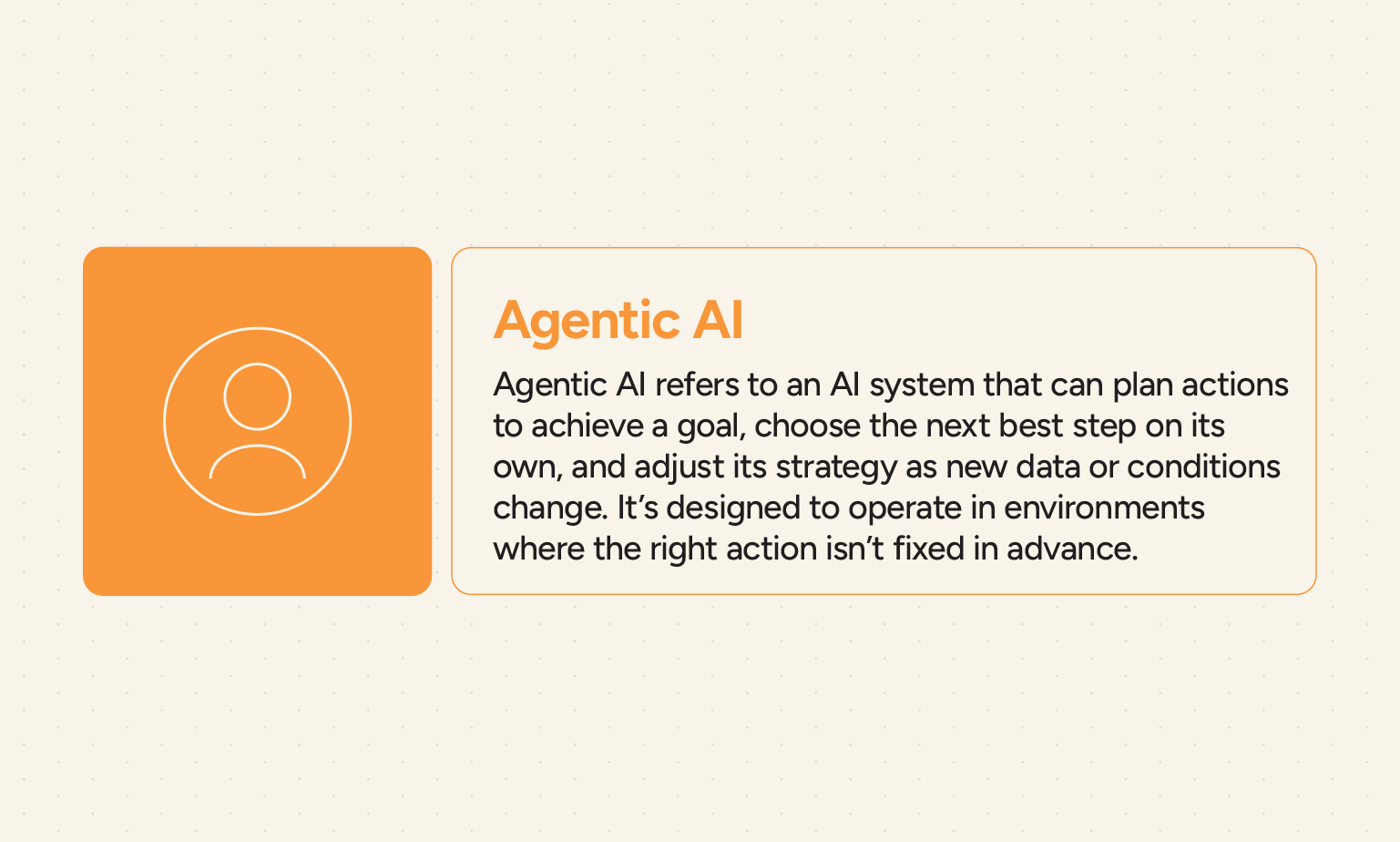
Unlike approaches that only interpret or generate information, this type of system can monitor what’s happening, reason about possible next steps, execute actions across different tools, and refine its behavior as it learns more.
These capabilities make agentic AI a strong fit for processes where the sequence of steps can shift based on real-time signals or evolving behavior. Instead of following a strict script, the system uses ongoing feedback from its environment to decide what to do next, allowing it to adapt as circumstances change.
What are the key characteristics of agentic AI?
- Goal-oriented behavior: Acts toward an outcome rather than following a linear sequence.
- Continuous monitoring: Watches for changes in data, events, or user activity.
- Adaptive decision-making: Chooses the next step based on current conditions.
- Action execution: Can trigger tasks across different tools or systems.
- Feedback loop: Evaluates results and refines its approach over time.
When to best use agentic AI?
Agentic AI is the right fit when:
- The workflow involves changing or unpredictable conditions.
- Decisions depend on multiple signals rather than a single rule.
- You need the system to choose and execute actions, not just analyze.
- The outcome matters more than following a fixed set of steps.
- Real-time adjustment can meaningfully improve results.
What's an example of agentic AI?
Picture a workflow designed to help reduce customer churn. Instead of relying on a single rule, like flagging a user after 30 days of inactivity, the system keeps an ongoing view of multiple signals: how often someone logs in, which features they use less, the tone of their recent support messages, or whether they stalled during onboarding.
When the system notices a combination of behaviors that suggest a customer might be losing interest, it chooses the most suitable next step for that specific person. That could be offering a discount, suggesting a helpful tutorial, or sending a personalized check-in message. It then takes that action automatically.
Once the action is sent, the system watches how the customer responds. If nothing changes, it can try a different approach. If engagement improves, it adjusts accordingly. This cycle of monitoring, deciding, acting, and refining is what sets agentic AI apart; it adapts in real time rather than following a fixed, one-size-fits-all rule.
A practical comparison: When to use which
How these approaches work together
Automation doesn’t fall neatly into one category anymore. In practice, the most effective workflows draw on more than one of these approaches, depending on what each part of the process requires. A workflow might start with traditional automation to handle predictable steps, use generative AI to make sense of unstructured data, and rely on an agent to decide what to do next based on what it observes in real time.
Matching the method to the task is what makes a workflow both efficient and adaptable. Some steps need clear rules, others need flexible interpretation, and some benefit from a system that can make choices and adjust as conditions change.
KNIME doesn’t lock you into a single type of automation. Instead, it provides a platform where rule-based workflows, generative AI, and agentic capabilities can work side by side, depending on what your use case calls for. You can start with the essentials, add intelligence where it makes an impact, and adopt more adaptive approaches whenever you’re ready.
It’s not about picking one style of automation. It’s about building the combination that best supports your work, today and as your needs evolve.