
As we enter 2026, auditors have access to unprecedented volumes of data. Equipped with modern audit analytics software, the audit function can move beyond small samples to analyzing entire populations, and leverage advanced agentic techniques for faster, more adaptive audit work. But, as organizations increasingly deploy AI and automated tools, they find themselves with a governance gap.
Without clear governance over how AI models are approved, monitored, and updated, audit teams will lose the ability to explain results and demonstrate compliance to regulators and stakeholders.
This is a growing concern as regulators scrutinize AI use, and frameworks like the EU AI Act raise the bar for explainability and accountability.
The challenge ahead is to ensure modern audit analytics remains explainable, governed, and grounded in high-quality data.
This article looks at challenges facing the audit function, what modern audit analytics delivers, and highlights real-world use cases, before discussing the governance gap and how it can be closed with visual audit analytics software.
Three converging pressures challenge the audit function
- Regulatory expectations are intensifying. The Institute of Internal Auditors updated its Global Internal Audit Standards in 2024. It now requires Chief Audit Executives to develop comprehensive strategies, not just for audit execution, but for resources, technology, and assurance work across the organization.
- In Europe, new directives like NIS2 and DORA impose cybersecurity requirements that require continuous monitoring.
- In the United States, evolving strategies for operating in cyberspace and scrutiny from regulators mean audit teams must demonstrate rigor and quality at unprecedented levels.
- Data volumes and complexity have exploded. Modern audit data spans ERP systems, cloud platforms, HR databases, external datasets, and unstructured sources like emails and contracts. Without advanced analytics, reconciling inconsistencies across these systems consumes more time than analyzing actual risks. Teams become overwhelmed with data preparation, limiting their ability to deliver timely, valuable insight.
- Stakeholder demands have fundamentally shifted. According to Forbes and KPMG research:
- 62% of stakeholders want auditors to articulate clear points of view on critical issues, reflecting a demand for more than compliance verification
- 47% want more transparency in how audit opinions are formed
As expectations rise to meet these pressures, both internal and external auditors face similar hurdles.
4 challenges shared by internal and external audit
- Legacy tools and manual processes isolate knowledge:
- Many audit teams still rely on spreadsheets or software such as ACL or IDEA, often managed by a single “analytics champion.” This isolates knowledge and limits scalability, making it difficult to share expertise, maintain consistency, or expand analytics capabilities across the broader audit function.
- Resource constraints slow the audit process:
- Audit teams are under pressure to do more with less. Smaller teams struggle to deploy data analytics at scale or build advanced models. This slows the audit process and increases the risk of missed anomalies.
- Data complexity has teams spending too much time on data preparation:
- Audit data now spans ERP systems, cloud platforms, and external sources. Without modern analytics, reconciling inconsistencies consumes more time than analyzing risks. As a result, teams can become overwhelmed with data preparation, limiting their ability to deliver timely, valuable insight.
- Evolving expectations add pressure to demonstrate value:
- External auditors face increasing scrutiny over audit quality and independence. Internal auditors are expected to contribute strategic insight, not just compliance checks. These rising expectations add pressure to demonstrate value, agility, and data-driven assurance.
The opportunities of modern audit analytics
These challenges are significant, but with modern audit analytics a transformation is possible. By applying data science, AI, and integrating agentic systems into the process, audit functions are turning from reactive compliance checkers to strategic partners.
So, what is modern audit analytics?
Audit analytics refers to the use of data science and AI techniques to extend the strengths of traditional auditing and enhance the accuracy, efficiency, and insight of audits.
By embedding data-driven analytics into daily workflows, audit teams can uncover hidden risks, strengthen internal controls, and provide proactive assurance to management and regulators alike: Audit analytics transforms auditing from a reactive exercise into a proactive, continuous process.
Instead of reviewing static samples, auditors can use analytics to:
- Analyze entire populations of transactions
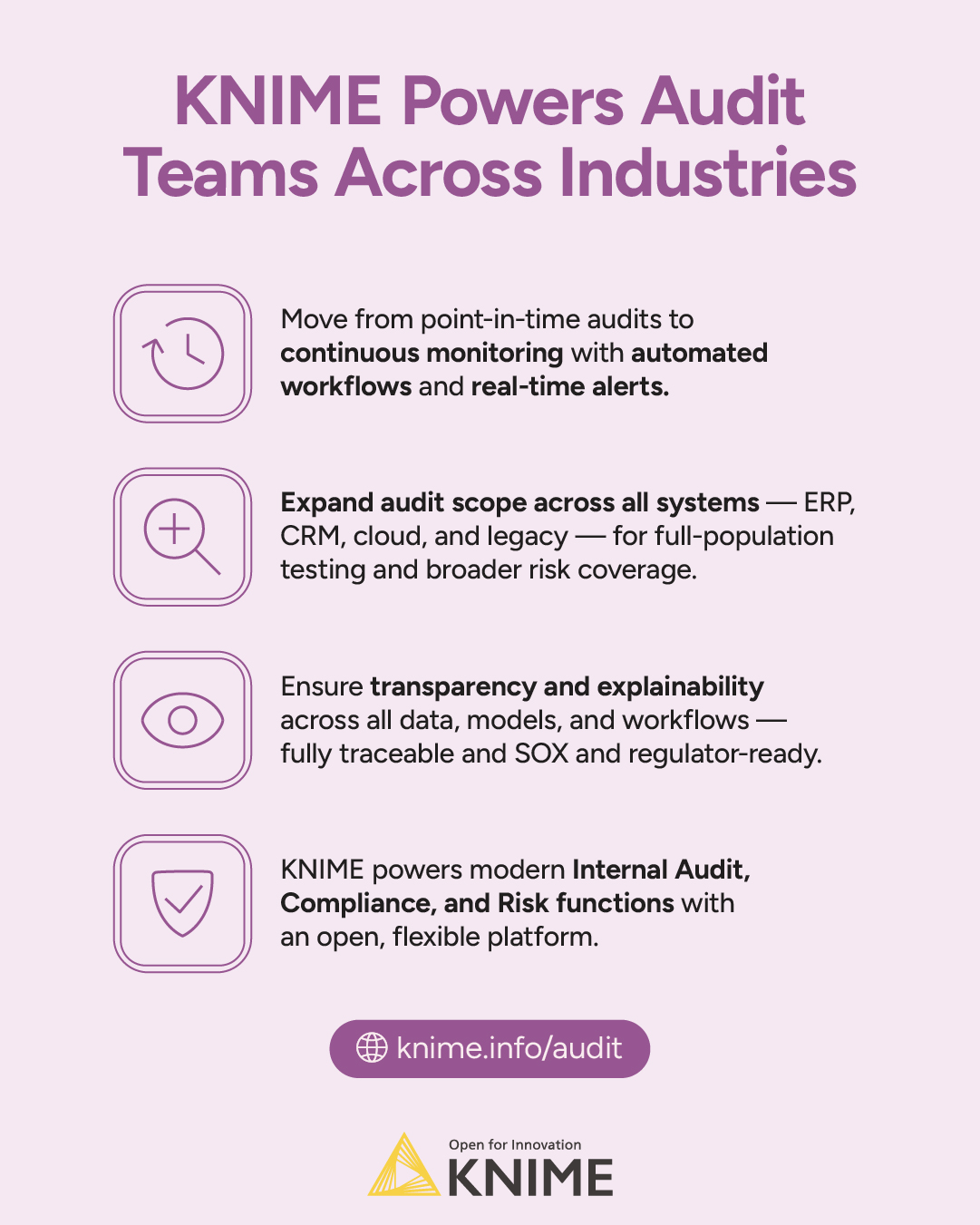
- Move from point-in-time audits to continuous monitoring with automated workflows and real-time alerts
- Leverage advanced AI and machine learning to enhance audit insights and risk detection
- Maintain full detail and drill-down across complex audit data, instead of relying on black-box models
- Automate repetitive tests from data access and blending to control testing, exception analysis, and risk reporting
How audit analytics is transforming the audit
Machine learning, AI, and agentic systems are transforming what’s possible in the audit process. Where traditional audits often relied on point-in-time fieldwork or limited sampling, which can miss critical risks, modern audit analytics enable auditors to test 100% of the data, uncover hidden anomalies, and build repeatable, scalable workflows.
With audit analytics, auditors can move beyond assurance and deliver strategic foresight that directly supports organizational goals. For example, identifying emerging fraud patterns across business units before losses occur, or analyzing control performance trends to advise management on where to strengthen governance and mitigate future risks.
In addition to moving from sampling to comprehensive testing and full-population analyses, here are just some examples of how audit analytics is transforming the audit:
- Enhanced and predictive risk assessment: Data science and AI techniques can identify emerging risks, allowing auditors to raise early alerts and help management take preventive action. Models can analyze millions of transactions to flag unusual behaviors — such as split transactions just under approval limits or even-dollar entries that suggest manipulation.
- Continuous monitoring: Instead of point-in-time assessments, analytics supports tracking risk and control performance in real time. This positions internal auditors as partners in risk management rather than a monitoring role.
- Integration of multiple data sources: Modern analytics leverages data blending, ETL (extract, transform, load) processes, and machine-learning techniques to combine information from disparate systems such as ERP platforms, HR databases, and external datasets. As a result, auditors can get a unified comprehensive view of all the organization’s data. This enables cross-system validation and deeper insight into risk patterns.
- Automation of routine tasks: Repetitive procedures, such as data validation or duplicate detection can be automated, freeing up time for more strategic work. Advanced analytics techniques reduce manual effort and ensure more consistency across audit tests.
With modern audit analytics software, teams are shifting from confirming what happened and why, to forecasting.
The reality: Governance lags behind AI innovation
The shift to apply modern audit analytics is already underway. According to Gartner's 2025 survey of Chief Audit Executives, 80% ranked advancing auditors' use of data and analytics as a top priority. Organizations implementing comprehensive audit analytics programs report significant returns through both direct cost savings and indirect benefits from improved risk management.
“83% of audit functions are piloting or using AI”, says Margaret Moore Porter, Chief of Research for Gartner Risk & Audit Practice. However, the report also revealed a confidence gap in addressing technology challenges. Confidence is at its lowest in providing assurance over generative AI.
The governance gap is created when rapid adoption of AI technology outpaces the development of a suitable oversight framework.
It’s the black box problem. When a company invests in AI but fails to get results, it’s often because they can’t govern or audit their black box solutions. For example:
- How do you ensure data security if you don’t know where the data is being processed or stored
- How can you be sure the AI isn’t hallucinating if you can’t see how it reasons?
- How can you provide a regulator with evidence of how a result was derived, what data was used, etc. if there is no audit trail?
KPMG, one of the leading auditing and consulting firms, cautions: “With AI’s growing importance and rapid deployment, audit committees should be addressing its governance and risk management.”
Many organizations hesitate to adopt AI-driven approaches in audit because they correctly recognize that "black box" systems cannot satisfy audit standards. The solution is to use a “glass box” approach.
Transparent architectures Visual, workflow-based platforms, like KNIME, are transparent by design. Instead of complex code you have visual workflows that define what an agent is allowed to do. The entire process, from authentication to defining the tools the agent can use and its capabilities, is visual, transparent, and self-documenting.
Watch The Workflow as a Canvas for Human-AI Collaboration and learn why the workflow is the most transparent and trustworthy way to work with AI.
Data security and sovereignty are paramount. With KNIME, you separate your AI agents from the underlying data with a layered architectural approach. The AI interacts with data only through defined, secure tools. This design ensures that while the agent can process and analyze data, the raw data, sensitive configurations, and sensitive data are not directly exposed to the AI.
Control frameworks define what AI systems can and cannot do. By explicitly granting AI access only to approved tools and data sources, organizations maintain governance while enabling automation. Systems have only the access they need to perform their designated functions.
Explore use cases: Audit tests with a modern audit analytics software
Here are some examples of audit tests you can do with the open source data science tool, KNIME Analytics Platform.
Audit test workflows with KNIME
| Area | Audit Tests | Control Objective |
| 1. Data Integrity and Duplicates | Incorrect totals, duplicate transactions, fuzzy name matches | Detect data errors early and ensure accuracy |
| 2. Fraud and Red Flag Analytics | Split transactions, even-dollar entries, matched data across systems | Identify suspicious behaviors and potential fraud |
| 3. Trend and Outlier Analysis | High standard deviation, transaction volume summaries | Spot abnormal fluctuations and emerging risks |
| 4. Timeliness and Aging Tests | Transaction aging, suspicious date ranges | Ensure proper timing and detect backdating or premature postings |
Read about them in more detail in this article, 10 Ready-to-Use Audit Test Workflows: KNIME for Audit.
An example of an Agentic Audit Assistant in action
Emerging applications combine AI agents with transparent, visual workflows to create powerful and governable automation.
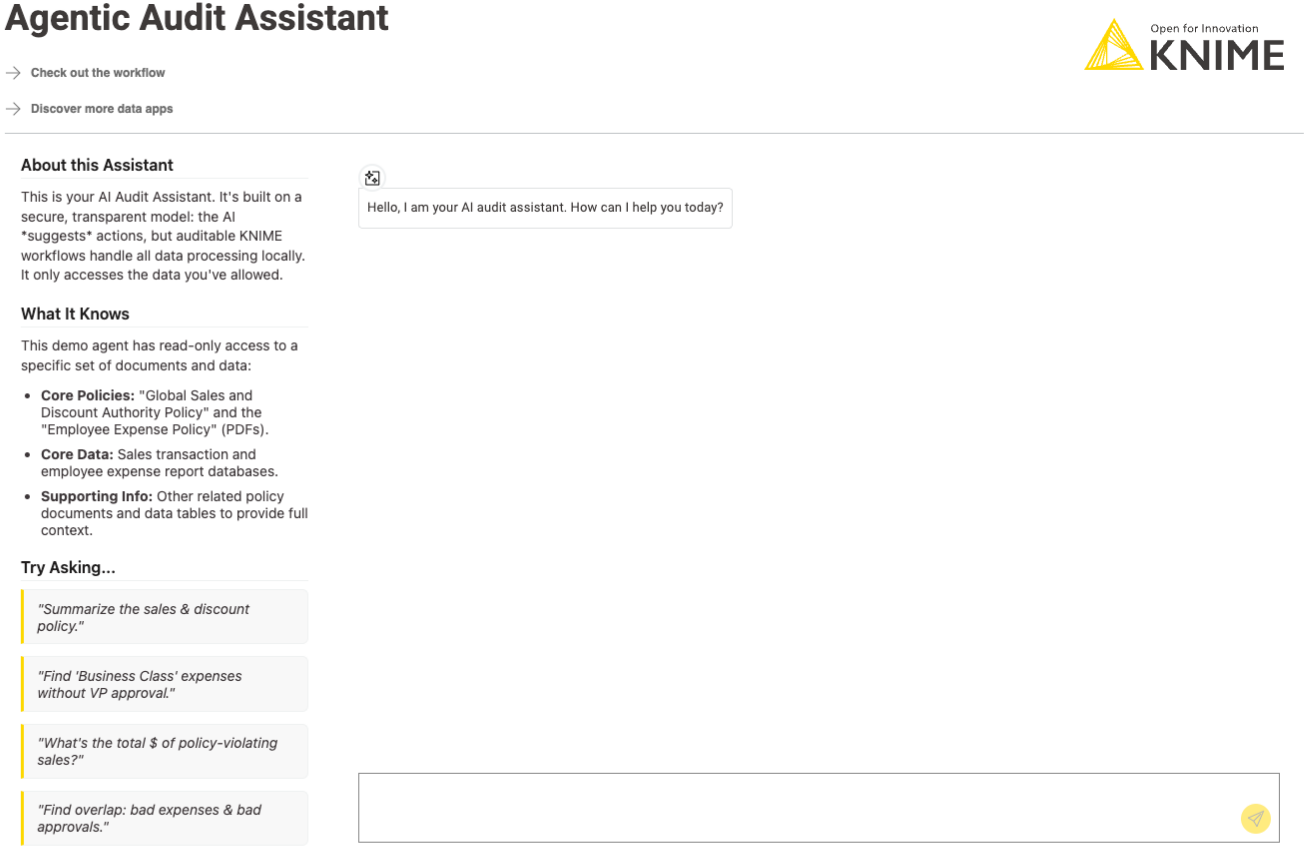
Rather than spending hours locating relevant policy provisions in extensive documentation, auditors can ask natural language questions: "What are the pre-approval requirements for business class air travel?" The system retrieves relevant policy documents, extracts applicable rules, and summarizes requirements in plain English.
Follow-up questions leverage the same intelligence: "Show me every expense claim for business class travel that lacks the required VP approval." The system queries transaction databases, applies the policy rules it previously extracted, and returns non-compliant transactions.
Complex queries that span multiple data sources become simple: "Is there any correlation between employees who frequently submit out-of-policy expenses and those who approve non-compliant sales discounts?" The system performs cross-system analysis, identifying relationships that would require days of manual investigation.
This approach demonstrates how AI can amplify auditor capabilities while maintaining transparency and control. Every step—document retrieval, rule extraction, data querying, analysis—occurs through visible, auditable workflows. The AI reasons about what to do, but executes through controlled tools that maintain security and traceability.
Where can I find audit analytics software?
For auditors looking to begin or expand their use of audit analytics, the ideal software is one that makes advanced analytics and AI techniques accessible without requiring a background in programming.
The goal isn’t to turn auditors into data scientists, but to give them tools that amplify their expertise and allow them to explore data, analyze it, and uncover insights easily.
Low-code and visual workflow platforms offer exactly that balance. They enable auditors to design, execute, and automate audit tests through intuitive drag-and-drop interfaces, reducing technical barriers while maintaining full transparency over every step. This allows audit professionals to combine their specialist judgment — their understanding of controls, risks, and context — with the power of modern data analytics. The result is faster, more reliable, and more insightful work.
The cherry on the cake is when it’s open source. Open-source software evolves continuously with contributions from a global community of data and AI practitioners. This means auditors benefit from the latest advancements in analytics, machine learning, and automation — innovation that closed, proprietary systems often struggle to keep pace with.
For teams seeking to meet new standards, strengthen controls, and modernize their approach, adopting a low-code, open-source analytics platform offers a practical and future-proof path toward smarter, data-driven auditing.